
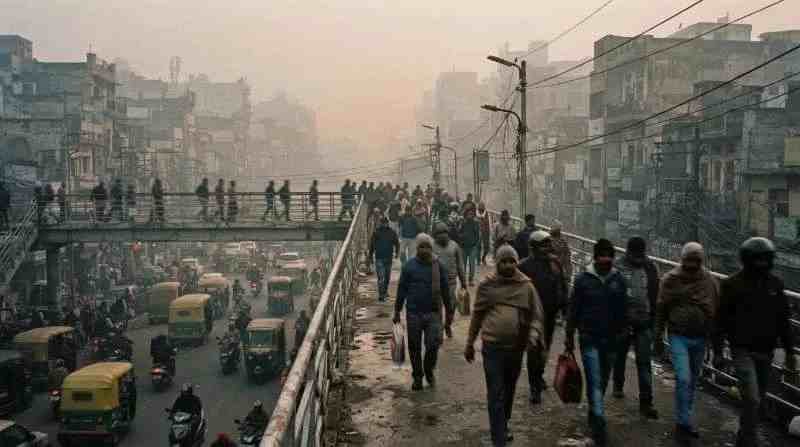
Delhi air pollution is “poor” this morning, and the stage of the Graded Response Action Plan (GRAP) in force is II. This page is a working guide: a snapshot of today, what to do at each AQI level, and what the GRAP stage does and does not mean for you.
Step 1: Find your own station, not the city average
The citywide figure hides big gaps. On 25 November, Lodhi Road read 176 while DTU read 331, a difference of more than 150 points. Open the CPCB’s AQI dashboard or its Sameer app, pick the station nearest your home, school or office, and use that number.
Apps often disagree because they use different monitors, averages and scales, and because Delhi’s air tends to worsen after dark and ease by afternoon. A private tracker showed a US-scale 172 on the afternoon of 25 November, while the CPCB-based citywide reading that morning was 224. Both can be right.
Step 2: Match Delhi air pollution levels to what you do
The main pollutant on most Delhi winter days is PM2.5, particles thinner than 2.5 micrometres that can reach deep into the lungs. India’s 24-hour standard for PM2.5 is 60 micrograms per cubic metre, while the World Health Organization’s 2021 guideline is 15. So a day that looks acceptable against the national standard can still be well above the WHO yardstick, which is one more reason to act on the band, not only on the stage.
A cloth or loose surgical mask is not built to filter fine particles. Indoors, avoid adding smoke from incense, mosquito coils or burning waste, and watch children, older adults, pregnant women and anyone with a heart or lung condition more closely.
Step 3: Read the GRAP stage as an order to agencies
The Commission for Air Quality Management (CAQM) runs GRAP in four stages tied to AQI bands: Stage I for 201–300, Stage II for 301–400, Stage III for 401–450 and Stage IV above 450. Each stage keeps the earlier steps and adds more. It acts on forecasts too: on 6 November it invoked Stage III after a citywide average of 382, because the air was expected to worsen ahead of Diwali. Stages are withdrawn only after the air stays cleaner for a while, which is why Stage II is still on at about 220.
Actions listed in each GRAP stage, revised schedule
The September revision merged repeated dust, waste and transport rules into Stage I, which is why it lists 25 steps. At Stage III, expect a ban on non-essential construction and curbs on older petrol and diesel four-wheelers. Stage IV adds the harshest steps, including limits on truck entry. After the November 2025 revision, offices and schools are a state-government decision from Stage III. Check CAQM’s order for the exact list on any day; details have been revised more than once.
A stage tells agencies what to enforce. It is not a health warning for you, so keep following the AQI band above, even when the stage sounds mild.
Step 4: Watch for what changes next
- IMD’s air-quality early-warning forecasts and morning fog, which can trap pollution.
- Any CAQM order moving Delhi up or down a stage.
- The Supreme Court, which has indicated it may consider allowing only BS-VI vehicles in Delhi. No order has been reported as of 26 November.
This is general information, not medical advice. If you have asthma, a heart or lung condition, or are pregnant, please follow your doctor’s advice on precautions and medicines. Figures checked on 26 November 2026 and change through the day.
Also read: How to read food labels in India · Salt and sugar intake in India
Sources
Read next



Discover more from Khabar Mitra
Subscribe to get the latest posts sent to your email.