
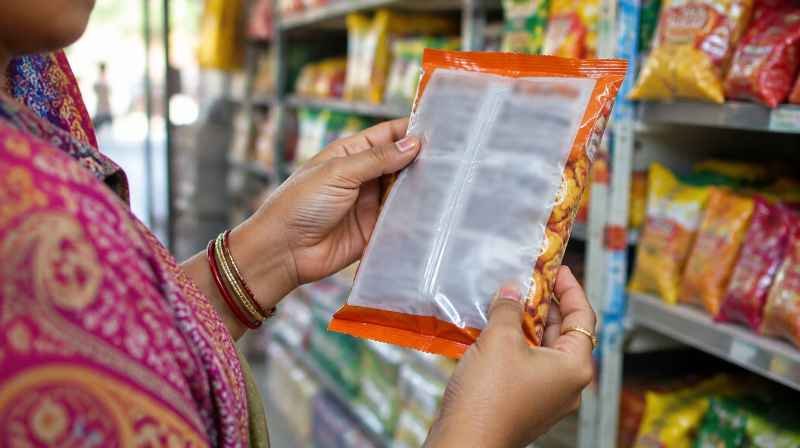
To read food labels well, skip the front of the pack and turn it over. The back carries the figures FSSAI makes every company print, and two minutes with them tells you more than any “healthy” badge on the front.
This matters now because the Supreme Court is weighing a red warning label for packaged foods high in sugar, salt or saturated fat. Until any such label reaches shelves, the nutrition table is the only honest summary on the pack.
What must every packaged food label in India show?
Under FSSAI’s Labelling and Display Regulations, 2020, a pre-packed food has to list its ingredients, nutrition per 100 g or 100 ml, energy, protein, carbohydrate, total and added sugar, total and saturated fat, trans fat and sodium. It also needs the veg or non-veg mark, the FSSAI licence number, the best-before or use-by date and any common allergens.
Ingredients are listed in descending order of weight. If sugar, maida or palm oil is the first or second ingredient, that is most of what you are paying for.
Why compare per 100 g and not per serve?
The company chooses the serving size. A 150 g namkeen pack may list a serve of 30 g, which makes the salt and fat look small. Per 100 g is fixed by law, so it is the only column that lets you compare two brands fairly.
Take two chiwda packs on the same shelf. If one shows 700 mg sodium per 100 g and the other 1,100 mg, the second has about 57 per cent more salt, whatever their serving sizes say.
How do I turn sodium into salt?
Multiply sodium by 2.5. A label showing 800 mg sodium per 100 g means about 2 g of salt in every 100 g of the food.
ICMR’s National Institute of Nutrition (NIN) puts the healthy limit at 5 g of salt a day for an adult, which is 2,000 mg of sodium. So one 100 g bowl of that snack would use up about 40 per cent of the day’s salt before you add any at home.
What does the %RDA figure mean, and why can it mislead?
Many packs show each nutrient as a percentage of a daily reference value, based on a 2,000 kcal diet. FSSAI’s reference values include 67 g total fat, 22 g saturated fat, 2 g trans fat, 50 g added sugar and 2,000 mg sodium.
The sugar figure is the catch. NIN’s 2024 guidelines say sugar should stay under 5 per cent of energy, about 25 g a day on 2,000 kcal. That is half of the 50 g reference most labels use.
| Label says | Added sugar | Share of NIN’s 25 g daily limit |
|---|---|---|
| 10% RDA | 5 g | 20% |
| 20% RDA | 10 g | 40% |
| 40% RDA | 20 g | 80% |
So a drink showing “20% RDA” of sugar takes up 40 per cent of the limit India’s own nutrition institute recommends.
Where does sugar hide in the ingredients list?
When you read food labels for sugar, look at added sugar in the nutrition table first. Then scan the ingredients for its other names: sucrose, glucose, liquid glucose, dextrose, maltodextrin, invert sugar syrup, fructose, honey, jaggery and fruit juice concentrate. Several of these spread through a list can add up to more sugar than any single ingredient.
NIN’s guidelines also warn that “sugar-free” foods are not automatically low in calories. They can still be made with refined flour, fat or sugar alcohols, so check the energy and fat figures too.
Which claims on the front of the pack should I doubt?
FSSAI’s Advertising and Claims Regulations, 2018 limit how words like “natural”, “fresh”, “pure”, “original” and “traditional” can be used, and nutrient claims such as “low fat” or “high fibre” must meet set limits. Some cases worth knowing:
- “100% fruit juice”: in June 2024 FSSAI told companies to drop this claim, because the rules have no provision for it and many such juices are made from concentrate and water. A juice made that way must say “reconstituted”, and one with more than 15 g of added sweetener per kg must say “sweetened juice”.
- “Health drink”: Indian food law does not define the term. In 2024 FSSAI asked e-commerce sites not to list dairy- or malt-based drink mixes under it.
- “Fortified” or “with vitamins”: NIN notes that adding vitamins does not make an ultra-processed food wholesome. Check the sugar and fat anyway.
- “Multigrain” or “atta”: look at the first ingredient. If it is refined wheat flour (maida), the grain claim is a small part of the product.
What is changing: the red warning label
On 28 August 2026 FSSAI told the Supreme Court it would use a red hexagonal warning on the front of packs high in sugar, salt or saturated fat, using NIN’s 2024 thresholds. At the 28 September hearing it proposed a one-year voluntary period, which the bench questioned before reserving its judgment.
Update, 24 November 2026: the court asked both sides for written submissions after the 28 September hearing and said it would then pronounce its order. We found no reported ruling as of this date. We will update this guide when the court decides or FSSAI notifies the rule.
If the label arrives, it will flag a problem at a glance. It will not tell you how much salt you are eating, so the nutrition table will still matter.
A two-minute checklist to read food labels at the shop
- Read the first three ingredients.
- Compare brands on the per 100 g column only.
- Multiply sodium by 2.5 to get salt.
- Halve your trust in the sugar %RDA: NIN’s limit is about 25 g, not 50 g.
- Check that trans fat is zero or close to it.
- Treat front-of-pack words as advertising until the back confirms them.
For how much salt and sugar Indians actually eat, and how the daily limits work out in rotis, chai and namkeen, read our data guide to salt and sugar intake.
This is general information, not medical advice. If you have diabetes, high blood pressure, kidney disease or another condition, please follow your doctor’s advice on salt and sugar.
Also read: How much salt and sugar Indians eat, and the daily limits · Why your kitchen bill keeps rising
Sources
- FSSAI: Food Safety and Standards (Labelling and Display) Regulations, 2020
- FSSAI: Food Safety and Standards (Advertising and Claims) Regulations, 2018
- ICMR-NIN: Dietary Guidelines for Indians, 2024
- Down To Earth: NIN guidelines on labels and sugar, May 2024
- All India Radio: FSSAI directive on “100% fruit juice” claims, 3 June 2024
- LiveLaw: FSSAI proposes red hexagonal warning labels, 29 August 2026
- LawBeat: Supreme Court reserves judgment on front-of-pack warning labels, 28 September 2026
Read next



Discover more from Khabar Mitra
Subscribe to get the latest posts sent to your email.