
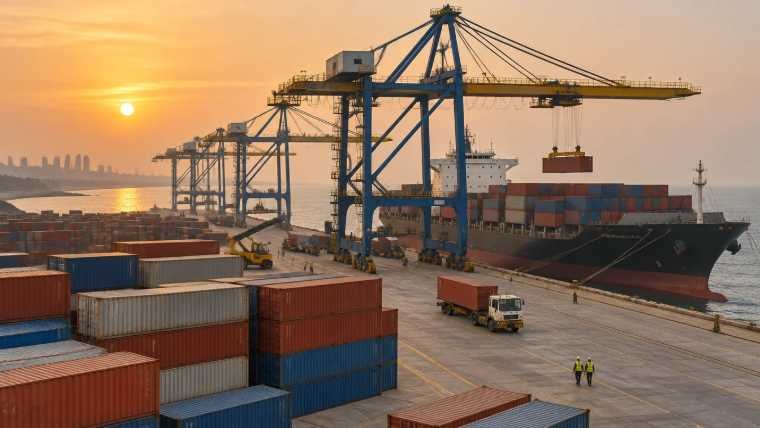
The United States has proposed a new US tariff on India of up to 25 per cent on most Indian goods, falling to 17 per cent if New Delhi signs a trade deal. US Trade Representative Jamieson Greer announced the plan on 25 November, after an eight-month probe into “excess manufacturing capacity” in India and 15 other economies.
Why it matters: the US is India’s biggest export market. Indian goods sent there were worth $87.31 billion in 2025-26, according to commerce ministry data. Today most of them face a 10 per cent baseline duty, Reuters reported. Either outcome on the table is higher than that.
Nothing changes yet. This is a proposal, the detailed product lists are still to be published, and the earliest the duties could start is January. Below we lay out the two scenarios and what each would mean.
What exactly has the US proposed?
The tariffs come under Section 301 of the US Trade Act of 1974, a law that lets Washington act against trade practices it calls unfair. USTR opened the investigation on 11 March 2026 into 16 economies, including China, the European Union, Japan, Vietnam and India.
On India, USTR’s findings, as reported by Business Standard and Reuters, point to industrial expansion plans, weak labour protections, market-access barriers and capacity in sectors such as pharmaceuticals and medical devices, steel, solar and ICT. Outlook reports the notice cites India’s solar module capacity at “nearly three times” domestic demand.
The new duty would replace the current 10 per cent rather than sit on top of it. It would not be added to existing US duties on steel, aluminium and cars, and oil and gas, critical minerals, fertilisers and some semiconductors and medicines are reported to be exempt. The full list has not been released.
How did we get here?
The US tariff on India has swung wildly in 16 months. In August 2025 it reached 50 per cent after an extra penalty linked to India’s purchases of Russian oil. A framework deal in February 2026 set an 18 per cent rate, but Business Standard reports it never took effect, because the US Supreme Court struck down the emergency-powers tariffs that same month. Section 301 is Washington’s way of rebuilding country-wise duties on firmer legal ground.
US duty on most Indian goods
Scenario 1: India signs the deal and pays 17 per cent
Take a worked example. A Tiruppur garment maker ships shirts worth ₹10 lakh to a US buyer. Today the buyer pays about ₹1 lakh in duty. At 17 per cent that becomes ₹1.7 lakh; at 25 per cent, ₹2.5 lakh. The US importer pays the duty, but in practice it often pushes the Indian supplier for a lower price.
What matters as much is the rate competitors pay. Reports differ on the exact figures, but Vietnam faces up to 35 per cent, China 20 per cent (possibly 40), and the EU, Japan and Switzerland roughly 15 to 20 per cent. Bangladesh, a big garment rival, is listed at 18 to 20 per cent. At 17 per cent India would be no worse off than most Asian rivals, which is the point commerce minister Piyush Goyal made on 15 November when he said India would get “lower duty than our competitor countries”, Open magazine reported.
The catch is the price of the deal. The 17 per cent applies only if India signs an agreement that addresses USTR’s findings, which could mean opening markets or changing industrial policy.
I think a lot of this is baked in.
Jamieson Greer, US Trade Representative, to CNBC, 25 November 2026
Scenario 2: no deal, and up to 25 per cent
A 25 per cent duty would put India above Bangladesh and the EU and level with or above several Southeast Asian exporters, depending on their final rates. Labour-heavy goods with thin margins, such as textiles, would feel it first, because buyers can switch suppliers quickly.
Exports have held up so far. Shipments to the US rose to about $51 billion in April to September 2026 from $45.73 billion a year earlier, All India Radio reported, citing the commerce ministry. That is growth of roughly 11.5 per cent by our calculation, helped by electronics, petroleum products and engineering goods. But that was at 10 per cent, not 25.
What India has said
The commerce ministry said it was examining the USTR notice, that India has no structural excess capacity in any sector, and that it remains committed to an early trade deal, Reuters reported. Commerce Secretary Rajesh Agrawal said last week that the first part of the deal was nearing conclusion. The Delhi think tank GTRI called the proposal an attempt to extract one-sided concessions, according to Business Standard. In its statement of 25 November, the ministry said trade concerns should be settled within the bilateral trade agreement talks (ANI). During the probe, India also questioned the basis of the excess-capacity charge and asked for the proceedings to be ended (Business Upturn).
A note on numbers: USTR puts India’s 2025 trade surplus with the US at $58 billion, while India’s own data show $34.41 billion for 2025-26. The two governments measure different periods and count trade differently, so the gap is not unusual. Our India-US trade explainer has the longer history.
What it means for you
For most households the effect is indirect. US duties are paid on goods entering America, so prices in Indian shops should not rise because of them. The risk is to jobs and incomes in export clusters, from garment units in Tiruppur to engineering firms in Pune and Ludhiana, if US orders slow.
If you work in an export business, watch for two things: the product lists in the US notice, and whether India signs the first part of the deal. Comments on the proposal are due by 5 January 2027 and hearings start on 25 January, Open magazine reported. Prime Minister Modi is expected to meet President Trump at the G20 summit in Florida in December.
The bottom line
Washington has offered India a choice between 17 and 25 per cent, both above today’s 10. The difference between the two is what a trade deal is now worth, and for exporters the rate that counts is how it compares with Vietnam, Bangladesh and China once the final numbers are out.
FAQ
Has the new US tariff on India come into force?
No. It is a proposal. Public comments and hearings come first, and the earliest final action reported is January 2027.
Will it make anything costlier in India?
Not directly. The duty is charged on Indian goods entering the US. The effect in India would come through export orders, jobs and company earnings.
Are medicines and smartphones covered?
Some pharmaceuticals and semiconductors are reported to be exempt, and products under separate US sector duties are excluded. The full product list has not been published, so it is not yet clear which Indian goods are in or out.
Also read: India-US trade in numbers: what a year of tariff whiplash did · 1.38 crore office jobs expected in 2027
Sources
USTR, “USTR Initiates Section 301 Investigations Relating to Structural Excess Capacity”, 11 March 2026; Reuters, “US to cap India tariff at 17% if trade deal is reached”, 25 November 2026; Business Standard and Bloomberg via Business Standard, 25 November 2026; Outlook India; Open; Atlantic Council; commerce ministry trade data via All India Radio and ANI via The Tribune.
Read next



Discover more from Khabar Mitra
Subscribe to get the latest posts sent to your email.
1 thought on “US proposes up to 25% tariff on Indian goods, or 17% with a trade deal: what it means for you”