
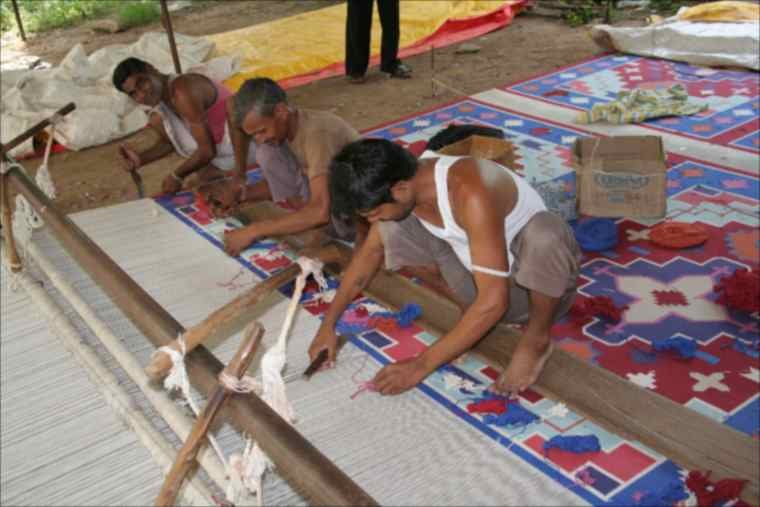
Smartphones, India’s biggest export to the US at $19.7 billion a year, are reported to be spared from the new US tariff on Indian exports, and so are steel, aluminium and many auto parts and medicines. The goods with the most to lose are smaller ones: carpets, shrimp, garments, handicrafts, leather and jewellery, which are made by millions of workers and sell heavily to American buyers.
Why it matters: on 25 November the US proposed a duty of up to 25 per cent on most Indian goods, or 17 per cent if India signs a trade deal, up from the 10 per cent most pay today. We explained the proposal here. This piece answers the next question: which industries, and which towns, would feel it first.
The US bought Indian goods worth $87.31 billion in 2025-26, about one in every five dollars India earned from merchandise exports, commerce ministry data show. Sales kept rising this year: $50.81 billion from April to September 2026, up 11.1 per cent, according to ministry figures.
What India sells to the US, and what is reported to be spared
The US has not yet published a final list, but its draft annex and early reports give a fair picture. Goods already under separate US sector duties (Section 232) are left out: steel, aluminium, copper, vehicles and many auto parts, wood products, patented medicines and semiconductors. Smartphones are named in the list of excluded products, NationPress reported, and so are many medicines packed for retail sale. Oil and gas are reported exempt too.
India’s exports to the US, $ billion a year
That split matters more than any headline rate. In 2025-26, Indian goods that paid US tariffs fell 11.2 per cent while goods on the exemption list grew 24.5 per cent, an ICRIER study found, Business Today reported. Smartphone exports to the US nearly doubled, from $10.6 billion to $19.7 billion, largely because phones were spared.
What “made in India” means here: these phones, mostly iPhones, are assembled in India by contract makers such as Foxconn, Tata Electronics and Pegatron, largely from chips, displays and cameras made abroad. The makers have crossed the government’s 20 per cent local value-addition mark, Outlook Business reported, and assembly itself is a small slice of a phone’s value, Business Today noted. The export figure counts the whole phone.
The real test: how much each industry depends on America
A dollar figure alone does not show the risk. A carpet maker that sells more than half its output to the US cannot easily find another buyer; an engineering firm that sells one-sixth there can. The chart below shows what share of each industry’s exports goes to the US.
Share of each sector’s exports that goes to the US
Put the two charts together and a clear list appears. The goods most exposed are those that are both covered by the proposal and heavily reliant on US buyers: carpets, handicrafts, shrimp, garments and home furnishings. Leather and jewellery are covered too, but sell more of their output elsewhere. Gems and jewellery have already shifted: the UAE overtook the US as their top market in 2025-26, after US-bound shipments fell 45 per cent, GJEPC data show.
A deliberate bait to extract one-sided concessions.
Ajay Srivastava, Global Trade Research Initiative, on the 17 per cent offer, to ETV Bharat
Srivastava argues the 17 per cent rate would give India an edge of only one to three points over rivals such as Bangladesh, Vietnam and China, ETV Bharat reported. For garments and shrimp, where buyers switch suppliers over a few cents, that gap is thin.
The towns behind these numbers
Who depends on these exports
Five export hubs, ranked by how much of their industry’s exports are sold to the US
Bhadohi and Mirzapur, Uttar Pradesh
Hand-knotted carpets; about ₹4,500 crore a year in direct exports from Bhadohi
Lakhs of weavers
No official count; figure as described by the Carpet Export Promotion Council
58%
of India’s carpet exports
Andhra Pradesh coast
Farmed shrimp; the state says it ships about 80% of India’s shrimp exports
About 30 lakh people
Working directly or indirectly in shrimp farming; Andhra Pradesh government estimate
About 39%
of India’s frozen shrimp exports (our calculation from MPEDA data)
Tiruppur, Tamil Nadu
Knitwear such as T-shirts; nearly 60% of India’s knitwear exports, worth ₹46,000 crore in 2025-26
More than 10 lakh jobs
In Tiruppur’s knitwear units; Tiruppur Exporters’ Association
32-33%
of India’s garment exports
Ambur, Vellore, Kanpur, Agra
Leather goods and footwear
44 lakh workers
In the leather industry across India, not only these towns; Council for Leather Exports
21%
of India’s leather and footwear exports
Surat, Mumbai, Jaipur
Cut and polished diamonds, and jewellery
About 12 lakh workers in Surat
GTRI estimate; about 42 lakh across the whole industry, says GJEPC
About 18%
of India’s gem and jewellery exports in 2025-26, down from about 32% a year earlier
Sources: Tiruppur Exporters Association; Andhra Pradesh chief minister via Business Standard; GJEPC via IBEF and GTRI; Council for Leather Exports; Carpet Export Promotion Council via IANS.
These are mostly small firms with thin margins. The US importer pays the duty, but buyers usually push part of it back onto the supplier as a lower price. A Bhadohi exporter shipping rugs worth ₹10 lakh would see the buyer’s duty bill rise from about ₹1 lakh today to ₹1.7 lakh at 17 per cent, or ₹2.5 lakh at 25 per cent.
What is still unclear
- Generic medicines: many retail-packed medicines are in the exclusion list, but it is not yet clear whether every generic drug India ships is covered.
- Refined fuels: oil and gas are reported exempt; whether petroleum products such as diesel count is not confirmed.
- Polished diamonds and other electronics: some raw materials and electronics appear in the annex with conditions attached, so their final status is open.
- Stacking: the new duty would not be added on top of the current 10 per cent. Where both apply, only the higher rate counts, Bloomberg reported.
Comments on the proposal are due by 5 January 2027 and a public hearing is set for 25 January, law firm Baker McKenzie noted. India’s commerce ministry has said the country has “no structural excess capacity in any sector”.
What it means for you
- If you work in an export cluster such as Tiruppur, Surat, Ambur or Bhadohi, watch for slower orders from US buyers in early 2027, especially if no deal is signed.
- If you run a small export unit, now is the time to talk to buyers about who bears the duty, and to look at markets such as the UAE, the UK and the EU, where India has trade deals or talks under way.
- If you are a shopper in India, nothing gets costlier directly. The duty is charged in the US. If exporters divert stock to the home market, some garments and seafood could even get cheaper here for a while.
- If you hold shares in textile, seafood or jewellery companies, expect news on the final product list and the trade deal to move prices. This is not investment advice.
Frequently asked questions
Which Indian exports would the US tariff hit hardest?
Labour-heavy goods that are covered by the proposal and sell a large share of their output to the US: carpets (58% to the US), handicrafts (40%), frozen shrimp (about 39%), garments (32-33%) and home furnishings. Leather and jewellery are also covered but less reliant on the US.
Are smartphones and medicines exempt?
Smartphones are named in the draft exclusion list, and patented drugs and many retail-packed medicines are excluded. Whether all generic medicines are spared is not yet confirmed.
How much does India export to the US?
Goods worth $87.31 billion in 2025-26, about 19.8% of India’s merchandise exports, and $50.81 billion in April to September 2026.
When would the new duty start?
Not before the comment period closes on 5 January 2027 and the hearing on 25 January. The rate would be 17% if India signs a trade deal, and up to 25% if it does not.
Also read: US proposes up to 25% tariff on Indian goods, or 17% with a deal · India-US trade in numbers
Sources
Commerce ministry trade tables, PIB; ministry data via Deccan Chronicle, 15 October 2026; ICRIER via Business Today; EEPC via IANS; ACMA via KNN; GJEPC via Outlook Business; MPEDA export figures 2025-26; Council for Leather Exports; GTRI via Outlook Business; commerce ministry data via ThePrint; ICRA via Apparel Resources; NationPress; India.com; Baker McKenzie; Bloomberg via Business Standard; ETV Bharat; Reuters via WKZO.
Read next




Discover more from Khabar Mitra
Subscribe to get the latest posts sent to your email.