
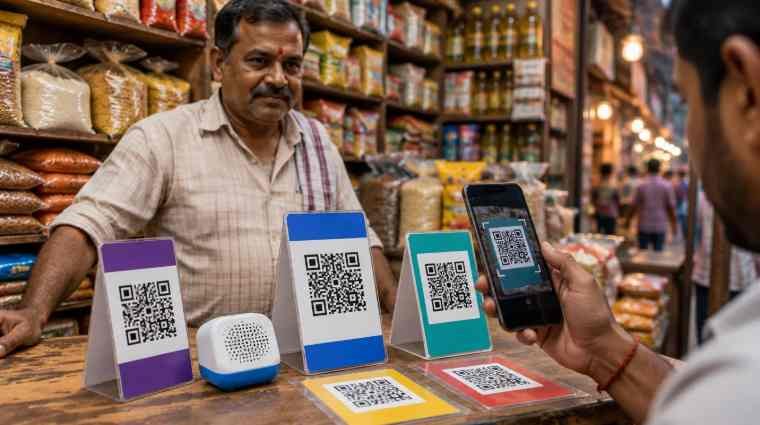
For six years, paying by UPI has cost nobody anything: not you, and not the shop you paid. That is about to change. Shops will soon pay a small fee on bigger UPI payments, and you have probably seen scary headlines saying “UPI is no longer free”.
Here is the calm version: who pays, how much, when it starts, and what it actually means for your wallet.
The short answer
- You don’t pay the fee. It is charged to the shop, not the customer, and shops are not allowed to add it to your bill.
- Sending money to friends and family stays free, whatever the amount.
- Shop payments of ₹2,000 or less stay free for everyone. That is the vast majority of UPI payments.
- It hasn’t started yet. The fee was due on 15 October but was postponed, and no new date has been announced.
What exactly is changing?
When a shop accepts a card payment, it pays its bank a small cut called the merchant discount rate, or MDR. UPI has had a zero MDR since January 2020, to get India using digital payments. It worked: UPI handled a record 25.47 billion transactions worth ₹31.53 lakh crore in October alone.
On 15 September, the National Payments Corporation of India (NPCI), which runs UPI, announced that this zero-fee era would end for bigger shop payments. Under the new framework:
- Shops pay 0.4% on UPI payments above ₹2,000, capped at ₹300 per payment (the cap kicks in at ₹75,000).
- Essential services such as railways, telecom, insurance, fuel, farm inputs and utility bills pay a flat ₹5 per payment above ₹2,000.
- Mutual funds and stockbrokers pay just 0.02%, also capped at ₹300.
What it looks like in real life
| You pay by UPI… | Fee the shop pays | Extra you pay |
|---|---|---|
| ₹1,500 at the kirana store | ₹0 | ₹0 |
| ₹3,000 restaurant bill | ₹12 | ₹0 |
| ₹4,000 electricity bill | ₹5 (flat) | ₹0 |
| ₹10,000 mutual fund SIP | ₹2 (0.02%) | ₹0 |
| ₹50,000 phone at a big store | ₹200 | ₹0 |
| ₹1,00,000 laptop | ₹300 (cap) | ₹0 |
| ₹25,000 rent to your landlord’s own account | ₹0 (person to person) | ₹0 |
Who is not affected at all
- Person-to-person transfers: splitting a bill, sending money home, paying a friend back. Always free.
- Small shops: vendors who receive up to ₹1 lakh a month through a UPI QR code into their own account pay no fee, even on a single payment above ₹2,000. Only if they cross ₹1 lakh a month for three months in a row do they move into the paying category.
- Everyday small payments: according to the government, payments of up to ₹2,000 make up more than 96% of UPI shop payments.
If a shopkeeper asks for “2% extra for UPI”, that is not allowed. You pay only the price on the tag.
Can a shop charge you extra for paying by UPI?
No. NPCI has told the Supreme Court that the ban on passing the fee to customers is a binding rule, not just a promise, enforced through the shops’ contracts with their banks. UPI apps such as PhonePe, Google Pay and Paytm are also not allowed to add a “platform fee” for UPI payments, and there is no monthly limit after which you start paying.
If a shop adds a UPI surcharge, ask them to remove it. If they refuse, raise a complaint in your UPI app (most have a “Help” or “Raise dispute” option for each payment) or with your bank.
But could prices go up anyway?
Possibly, a little. Critics point out that banning a surcharge doesn’t stop a shop from quietly raising prices for everyone to cover its costs. On the other hand, the fee is small (₹200 on a ₹50,000 purchase), and big retailers already pay higher fees on card payments without adding them to price tags. NPCI’s chief has said most of the fee will come from large businesses that already pay MDR on cards, and that about three-quarters of merchants won’t be affected at all.
So when does it actually start?
Nobody knows yet. Two days before the 15 October launch, NPCI postponed it until after Diwali, saying a new date would be announced separately. Diwali has come and gone, and there is still no date. Reports last week suggested the government, the RBI and NPCI have not agreed on timing, and that the fee could be pushed beyond next year’s assembly elections in states including Uttar Pradesh and Punjab.
There is also a court case. A petition in the Supreme Court challenges the fee and the law change behind it. The court refused to put it on hold in September and asked the government, RBI and NPCI to respond, so the case is still going on.
Why is this happening at all?
UPI was never truly free. Someone always paid to run it: banks, payment apps and the government, through a subsidy. Payment companies say that subsidy has gone unpaid for six quarters, while UPI keeps growing and fraud keeps getting more sophisticated. NPCI says the fee will pay for infrastructure, cybersecurity and fraud prevention, and that 5% of it will go into a fund to bring more small shops onto UPI, a scheme it has named UPI Vyapaar Saksham.
What you should do
- As a customer: nothing changes. Keep using UPI as you do now. Just don’t accept a “UPI charge” on your bill.
- Ignore forwards saying UPI will cost you money after a certain number of payments. There is no such rule.
- If you run a small business, check how much you receive by UPI each month. Below ₹1 lakh through a QR code into your own account, you stay fee-free. Above that, ask your bank what you will pay once the fee starts.
The bottom line
UPI is not becoming paid for you. When the fee does start, it will be the shop, not you, paying a small cut on bigger purchases, and only bigger shops at that. For now, even that is on hold. We will update this article when NPCI announces a date.
Frequently asked questions
Will I be charged for UPI payments above ₹2,000?
No. The 0.4% fee is paid by the shop, not the customer, and shops are not allowed to pass it on to you.
Is sending money to family by UPI still free?
Yes. Person-to-person transfers remain free at any amount.
When does the UPI merchant fee start?
It was due on 15 October 2026 but was postponed until after Diwali. As of 22 November 2026, NPCI has not announced a new date.
Do small shopkeepers have to pay the fee?
Not if they receive up to ₹1 lakh a month through a UPI QR code into their own account. They stay fee-free even on single payments above ₹2,000.
Sources
- Business Today: UPI MDR rules and FAQs (15 September 2026)
- Business Standard: UPI MDR deferred until after Diwali (13 October 2026)
- ThePrint: Supreme Court refuses to stay UPI MDR (28 September 2026)
- LiveLaw: NPCI tells Supreme Court merchants cannot pass on charges (5 November 2026)
- Elets BFSI: No rollout date yet; flat ₹5 likely for merchant-to-merchant payments (November 2026)
- Entrepreneur India: UPI hits record 25.47 billion transactions in October (3 November 2026)
- MediaNama: NPCI announces MDR-funded UPI Vyapaar Saksham scheme (November 2026)
Read next



Discover more from Khabar Mitra
Subscribe to get the latest posts sent to your email.