

AI could add tens of billions of dollars a year to India’s economy, studies say. But the gains are landing on a small group of workers, the first rung of the IT job ladder is wobbling, and this week the global markets betting on AI took a hard fall.
Four years ago, Tata Consultancy Services hired more than 1.1 lakh engineering graduates in a single year. In the year that ended in March 2026, it took in less than half that number.
For decades, that kind of mass hiring was how India’s software story worked. Companies took in fresh graduates by the lakh, trained them, and put them to work on coding and testing for clients around the world. Millions of families climbed into the middle class this way.
Now artificial intelligence is doing a growing share of exactly that work. And the man who speaks for the industry is not pretending otherwise.
“From a fresher’s point of view, it is a concern, and I will not sugarcoat it any differently,” Rajesh Nambiar, president of the IT industry body Nasscom, told Nikkei Asia this month. Basic coding and software testing, the jobs that have always given graduates their start, are increasingly being automated, he said.
Yet the same industry is still growing. Nasscom estimates it added about 1.35 lakh people in the year to March 2026, slightly more than the year before. So what is actually going on?
The productivity promise
Start with the good news. A study published this month by the IT company Cognizant estimates that AI could add between $28 billion and $84 billion a year to India’s economy, depending on how widely it is used. That’s roughly ₹2.6 lakh crore to ₹7.8 lakh crore.
Almost every employee it surveyed, 97%, said AI had made them more productive, by about 15% on average. Healthcare workers reported the biggest jumps.
But the same survey has a catch. Only about a third of employees actually have AI tools at work. And among business leaders, 84% said AI had not yet lowered their costs, and 91% said it had made no difference to revenue.
In other words, people feel faster. Companies are not yet seeing it in the accounts. The study itself calls its numbers directional, because they are built on what people say in a survey.
Who is getting the gains?
A recent IMF working paper tried to measure where AI’s benefits are going around the world. Its answer was blunt: rich countries capture 96% of them. AI’s gains are worth about 4.2% of GDP in high-income countries, but only 0.6% in middle-income countries like India.
Inside India, the gains are concentrated too. The IMF gave India a high score on its “AI concentration” measure, meaning the benefits are going mostly to software and science professionals. Teachers, office staff, shop workers and service employees are barely using it yet.
That matters because those are the jobs most Indians actually do. The paper’s advice is to spread AI into classrooms, offices, hospitals and shops, rather than only chasing the most advanced AI models.
The ratings agency Moody’s struck a similar note this month. It said India and the Philippines are the emerging economies most exposed to AI, because so much of their economies rest on IT and outsourcing work. AI could make that work more productive, or put people out of it. So far, Moody’s said, there is no clear sign of either.
The missing first rung
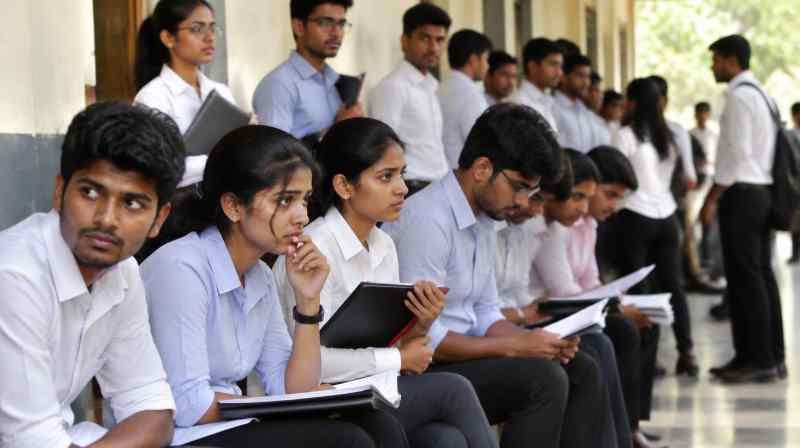
The pressure is sharpest at the bottom of the ladder. A survey of 651 IT firms by the research group ICRIER found that hiring had slowed most at entry level, even as demand grew for experienced people who can work with AI.
Indian companies estimate that AI already does about 37% of entry-level tasks, according to a study by Cognizant and Pearson. Cognizant’s India head, Rajesh Varrier, argues that this changes what a fresher does rather than wiping out the job. Freshers are not disappearing, he says, their work is changing.
There are some green shoots. Job site Naukri says AI and machine-learning job postings rose 32% in October compared with a year earlier, against 5% growth for IT jobs overall. And industry estimates suggest fresher hiring could recover to around 2.1 lakh in the coming financial year, though companies increasingly want AI, data and cybersecurity skills from day one.
The worry is a quieter one. If AI does the simple work that juniors used to learn on, how does anyone become a senior? Nasscom has urged colleges to go beyond basic coding and teach real engineering judgment and problem-solving.
Meanwhile, the markets blink
While India debates jobs, investors elsewhere are asking a different question: has the money poured into AI got ahead of the profits?
This week gave a jolt. AI developer Anthropic, the maker of the Claude chatbot, listed its shares in New York on Thursday in a record IPO. It closed its first day 17% up, but fell 8.5% on Friday as a wider sell-off in AI stocks deepened. Chipmaker Nvidia sank 14% that day, and the tech-heavy Nasdaq 100 had its worst week since March 2020.
Indian markets held up far better. On Friday, the Sensex and Nifty slipped only about 0.3% at the open, and IT shares held steady. Foreign investors have put more than ₹1 lakh crore into Indian shares this month.
Still, India is not cut off from what happens next. Moody’s lists weaker-than-expected returns from AI investment as one of the main risks to global growth next year. A slowdown in the global economy would reach Indian exports and IT orders soon enough.
What it means for you
If you are a student, the message from employers is consistent: basic coding alone is no longer enough to get hired. Learning to use AI tools well, along with data, cloud or cybersecurity skills and the ability to solve real problems, now matters from the first interview.
If you already work, in IT or anywhere else, the people gaining most are those who use AI to do their existing job better. That’s true whether you are a teacher, an accountant or a nurse, not just a programmer.
The government has set itself a big target here. In August, Prime Minister Narendra Modi announced a plan to train one crore young people in AI skills within a year. Whether that reaches the small-town graduate, and not only the big-city engineer, may decide how much of AI’s promise India actually captures.
The technology is arriving either way. The open question is who it works for.
Sources
- AI Weekly: Nasscom chief warns AI is squeezing India’s IT freshers out (Nikkei Asia interview) (November 2026)
- Magica: AI reshapes India’s graduate tech hiring (TCS intake figures) (November 2026)
- Business Today: IT industry added about 1.35 lakh employees in FY26, says Nasscom (24 February 2026)
- Analytics India Magazine: Cognizant study on AI and India’s GDP (5 November 2026)
- The Policy Edge: IMF measure shows AI gains concentrated in India (2026)
- What Moody’s says about AI and Indian IT jobs (12 November 2026)
- Magica: ICRIER survey of 651 IT firms on entry-level hiring (October 2026)
- Business Today: Freshers are not disappearing, their jobs are changing (16 November 2026)
- Masai: AI jobs in India (Naukri JobSpeak data) (November 2026)
- SightsInPlus: IT-BPM fresher hiring expected to recover in FY27 (24 October 2026)
- CNBC: Anthropic falls in first full day of trading as tech stocks drop (20 November 2026)
- Bloomberg: Wall Street reels as AI fears erupt (20 November 2026)
- HDFC Sky: Sensex, Nifty edge lower, bucking global sell-off (20 November 2026)
- ANI: Sensex, Nifty open lower amid AI-led global sell-off (foreign investment figures) (20 November 2026)
- IANS: AI skills training plan announced in August 2026 (5 November 2026)
Read next



Discover more from Khabar Mitra
Subscribe to get the latest posts sent to your email.