
Updated 22 November 2026 · 4 min read
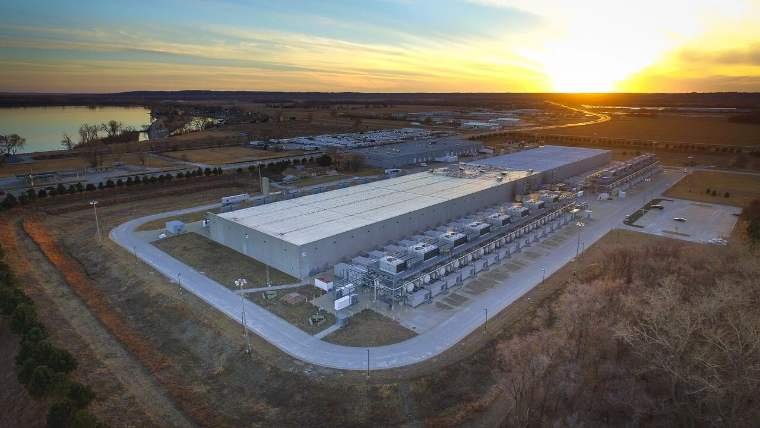
Top image: a Google data centre in Council Bluffs, Iowa. Photo: Chad Davis / Wikimedia Commons, CC BY 2.0 (resized).
Imagine spending billions on a giant building in Visakhapatnam, and then your own president says you are not allowed to build it. That is roughly the headache Google woke up to this weekend.
On Friday, 20 November, US President Donald Trump said American companies should not build data centres outside the US, and that those who do would face a “tremendous tax”. Within hours, Indian headlines were asking the obvious question: what happens to Google’s $15 billion AI hub in Vizag?
Short answer: nobody knows yet, including, it seems, Trump’s own team. Here is what we do know.
What exactly did Trump say?
Speaking at a White House press conference after returning from Asia, Trump said: “We’re not allowing data centers to go into other countries.” His reason was China. He argued that data centres built abroad could end up in Beijing’s hands, and that America lost its lead in chipmaking by letting companies build factories overseas.
He also suggested firms could still build abroad, but would pay a heavy price for it. And he made one striking admission: he had not yet told his own officials about the idea.
So is it actually a ban?
Not yet. Right now it is a statement, not a law or a signed order. Trump did not give:
- a tax rate or a start date
- a legal mechanism (in the US, new federal taxes normally need Congress)
- any word on whether projects already under construction would count
- any detail on whether renting space abroad is treated the same as owning a building
Markets took it seriously anyway. On Friday, Alphabet (Google’s parent) fell about 2.7%, Microsoft 2.8% and Amazon 4.1%, although that came during a wider tech sell-off, so not all of the drop was down to this.
Why Google is in the firing line
Trump’s real target looked like Google’s plans in Finland. In September, Google announced about €13 billion (roughly $15 billion) for data centres there, its biggest-ever investment in Europe, and Trump has publicly criticised it since.
But India is Google’s other big bet. In October 2025, it announced a $15 billion AI hub in Visakhapatnam, Andhra Pradesh: a gigawatt-scale data centre campus plus a new international subsea cable landing, built with partners including AdaniConneX and Airtel. Google calls it its largest AI hub outside the US, and ground work on the site was already under way this year.
Big Tech has pledged about $67.5 billion for India in roughly a year. That is what is suddenly in question.
How much of India’s AI boom is at stake?
A lot. India has become one of the biggest winners of the global data centre rush, and most of the money is American.
| Company | India commitment | Where |
|---|---|---|
| $15 billion, 2026–2030 | Visakhapatnam AI hub and subsea cable gateway | |
| Microsoft | $17.5 billion, 2026–2029 | Cloud and AI infrastructure, including a new Hyderabad cloud region, plus skilling |
| Amazon | $35 billion+ by 2030 | Across all its India businesses, including AI, data centres and logistics |
Add those up and Google, Microsoft and Amazon have pledged around $67.5 billion for India since October 2025, although Amazon’s figure covers its whole India business, not just data centres. The government has been rolling out the red carpet too: the 2026-27 Budget offered a tax holiday until 2047 for foreign companies serving global cloud customers from Indian data centres.
So what happens next? Three scenarios
- It stays talk. Without Congress or a clear legal route, the idea could stall, and Vizag carries on as planned.
- Existing projects survive, new ones slow down. For now, this looks the likeliest path. Projects already announced are unlikely to be dropped overnight, but future plans could be delayed, made smaller or quietly shifted to the US.
- A real tax that covers projects under way. The worst case for India. If a tax hit projects already being built, companies would have to rethink the numbers on Vizag and similar sites.
Is there a silver lining for India?
Possibly. If American giants hesitate, Indian players such as Reliance and Adani, along with investors from Japan, Singapore and the Middle East, could step in to fill the gap. Indian firms like Yotta and L&T are already building large AI clusters of their own, as we covered in our Nvidia and India explainer.
There is also an odd twist. At the same press conference, Trump talked up the AI initiative the US, India, Japan and Australia launched at their Quad summit in Manila just days earlier. So India is being invited into America’s AI club with one hand, while US companies are being warned off building there with the other.
The bottom line
For now, this is a warning shot, not a wall. Google’s Vizag hub has not been cancelled, and no rule exists yet that would stop it. But for an industry that plans in five-year, multi-billion-dollar chunks, uncertainty alone is costly. Watch for three things: whether the White House puts the idea in writing, how Google responds on Finland, and whether any Indian project gets delayed. We will update this story as it develops.
Sources
- CNBC: Trump vows to stop U.S. companies from building data centers abroad (20 November 2026)
- Bloomberg: Trump threatens to tax firms building data centers abroad (20 November 2026)
- Axios: Trump floats major tax on U.S. companies constructing data centers overseas
- The White House: Quad Leaders’ Summit joint press release (17 November 2026)
- TechCrunch: Google to invest $15B in Indian AI infrastructure hub (October 2025)
- Microsoft: US$17.5 billion investment in India (9 December 2025)
- Amazon: $35 billion investment in India by 2030 (10 December 2025)
- PIB: Budget 2026–27 sets the stage for India as a global hub for cloud and AI infrastructure
- 24/7 Wall St.: stock moves and what the announcement left out
Discover more from Khabar Mitra
Subscribe to get the latest posts sent to your email.