
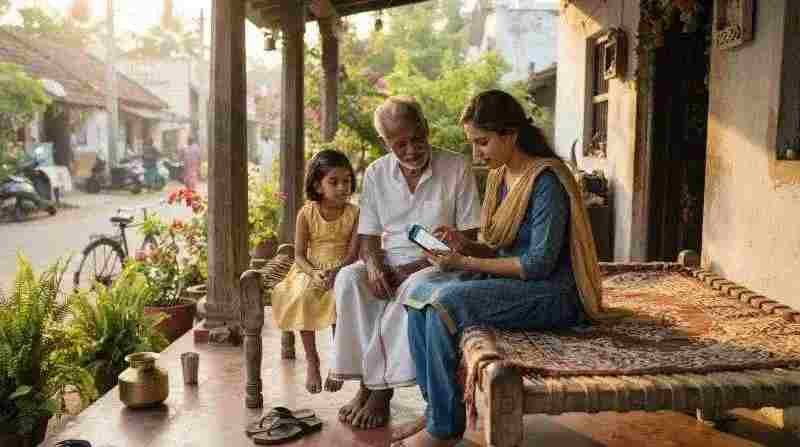
Census 2027 is India’s 16th census and the first to run digitally, with a caste count and a chance to fill in your own form online. The online self-enumeration window runs from 10 to 24 January 2027, house-to-house visits follow from 25 January to 28 February, and the reference moment is midnight on 1 March 2027. This guide explains how it works, what is new, and what you need to do.
A census is a head count with a long memory. Every policy that splits money, seats or jobs by population leans on it, and India has not had a fresh one since 2011. COVID delayed the 2021 round. So what follows are the basics first, and then the details that most coverage skips. Each “Knowledge bite” is a fact worth remembering on its own.
Knowledge bite: A census counts everyone, once, as of a fixed moment. A survey, by contrast, asks a sample. That is why census numbers can be broken down to a single village or ward, and a survey cannot.
What is Census 2027 and why is it special?
It is the 16th census in India’s history and the eighth since Independence, run under the Census Act, 1948. Three things set it apart: it is the first digital census, with enumerators using mobile apps; the first to let households self-enumerate online; and the first since 1931 to count every caste, not only Scheduled Castes and Scheduled Tribes. The Union Cabinet approved a budget of ₹11,718.24 crore on 12 December 2025.
The scale, moreover, is large: about 30 to 31 lakh enumerators and supervisors, covering 36 states and Union Territories, 7,092 sub-districts, 5,128 statutory towns, 4,580 census towns and roughly 6.39 lakh villages (figures reported by ANI from the Home Ministry).
Knowledge bite: A “statutory town” has a municipality or similar body by law. A “census town” has none but meets the census tests for being urban, such as size, density and the share of men working outside farming.
When will the Census 2027 count happen?
The census runs in two phases. The first, house-listing, ran state by state between 1 April and 30 September 2026, each in a 30-day window. The second phase, however, counts every person and is the one most households will notice. The Home Ministry notified its dates on 30 October 2026.
- 1–30 September 2026Snow-bound areasLadakh and parts of J&K, Himachal Pradesh and Uttarakhand are counted early, before winter closes the routes. Reference date: 1 October 2026.
- 10–24 January 2027Self-enumeration (online)You fill the form yourself and get a self-enumeration ID.
- 25 January–28 February 2027House-to-house enumerationAn enumerator visits, checks your ID or fills the form on a mobile app.
- 1 March 2027, 00:00Reference momentEveryone alive at this moment counts, wherever the census visit happens.
- 1–5 March 2027Revisional roundEnumerators cover missed households and corrections.
Knowledge bite: The reference moment is why a baby born on 2 March 2027 is not in this census but one born at 11 pm on 28 February is. The count describes India at one instant, even though visits take weeks.
What is self-enumeration and how do I do it?
Self-enumeration lets a household fill in its own census form online instead of waiting for a visit. Go to se.census.gov.in between 10 and 24 January 2027. The portal works in 16 languages. When you finish, it gives you a self-enumeration (SE) ID. So keep it: when the enumerator arrives after 25 January, they verify your ID and confirm details rather than asking everything again.
- Keep ready: names, ages and relationships of everyone in the household, and the details of the house you listed earlier.
- The form asks for Aadhaar, voter ID, mobile number and bank-account count only “if available”, so you do not have to have them.
- However, nobody has to self-enumerate. If you skip it, the enumerator will still fill your form on their visit.
Knowledge bite: Self-enumeration is a convenience, not a second count. The ID links your online form to your house, so you are never counted twice.
What is new in the Census 2027 questionnaire?
The questionnaire has 40 questions, notified on 14 August 2026. The 2011 census had 29, so 13 are new. The earlier house-listing round, which asks about your home and assets, had 33 questions (notified 22 January 2026).
Questions asked in the population enumeration
However, two details are easy to miss. Question 10 reads “Scheduled Caste (SC) / Scheduled Tribe (ST) / Caste”, so it carries the caste count inside the same question that always asked about SC and ST. And the fertility questions apply only to ever-married women.
Knowledge bite: Aadhaar, voter ID, mobile number and bank accounts are marked “if available”. That wording means a missing document cannot stop your household from being counted.
Why is the caste count such a big deal?
The Cabinet Committee on Political Affairs approved a caste count on 30 April 2025. India last counted every caste in the 1931 census. After Independence, the census counted only SC and ST. The government ran a separate Socio-Economic and Caste Census in 2011, but never released its caste data because of errors in the raw data. Since then, states have run their own surveys, such as Bihar’s in 2023.
What this changes: for the first time in nearly a century there will be a national, official figure for backward and other castes. As a result, that feeds debates on reservation limits, welfare targeting and political representation. It also carries real difficulties: caste lists differ by state, and the same community can have different names or classifications in different places. Therefore, treat any projection of what the numbers will show as a guess until the data is out.
Knowledge bite: The 1931 census was the last with full caste data. Since the first post-Independence census in 1951, only SC and ST have been counted.
Is my information safe and private?
Under Section 15 of the Census Act, individual census data is confidential. Nobody can obtain it through RTI, and courts do not accept it as evidence. The Registrar General says it encrypts the data and keeps it in critical-information-infrastructure data centres certified to ISO/IEC 27001:2022. In addition, on 26 October 2026 the RGI barred the release of provisional data.
Knowledge bite: Instead, only aggregate numbers, such as totals for a district or a village, are published. Your own form is never made public.
What is the census used for, and when do results come?
The census decides how many people live where and what they are like. Governments also use it for planning schools, health centres, housing and welfare schemes, and for drawing electoral boundaries. The 2011 census counted about 121 crore people, a sex ratio of 943 women per 1,000 men and a decadal growth rate of about 17.7 per cent. For comparison, the government released provisional totals for 2011 on 31 March 2011, within weeks of the count, while final tables came on 30 April 2013. The government has not announced an official date for Census 2027 results.
Seats and reservation. The Constitution freezes Lok Sabha seat numbers on the 1971 census until the first census after 2026, so Census 2027 is the one that can reopen the question of redrawing seats. The 2023 women’s reservation law also depends on the first census after it. Lok Sabha negatived a 2026 Constitution Amendment Bill (the 131st), which proposed 850 seats using the 2011 census, on 17 April 2026. PRS Legislative Research notes that delimitation on the 2027 census is unlikely to finish before the 2029 general election. Parties differ sharply on how to share seats, so we report the positions without taking one.
Knowledge bite: Delimitation means redrawing constituency boundaries and deciding how many seats each state gets. A census gives the population base; however, a separate Delimitation Commission does the redrawing.
A short history of counting India
- 1865–1872First attemptsFirst attempts to count, done region by region.
- 1881Synchronous censusThe first census that counted the whole country together.
- 1931Caste countLast census with full caste data.
- 1951After IndependenceFirst post-Independence census; only SC and ST counted.
- 201115th censusAbout 121 crore people.
- 2021PostponedCOVID delayed the count.
- 202716th censusFirst digital census; the caste count returns.
What should I do before the census visit?
- Before 10 January: collect basic details of each household member: name, age, relation to the head, education, work and marital status.
- 10–24 January: fill the form at se.census.gov.in and note down your SE ID.
- From 25 January: keep the SE ID handy for the enumerator. If your house is locked, tell the neighbours or leave a note so the enumerator can revisit.
- Be careful: only the official portal and enumerators with ID cards are genuine. The census does not ask for OTPs, bank passwords or money.
- Check your own state’s schedule on the Census India website, as local dates can vary.
We could not verify the list of areas that some reports say the digital count excludes, so we have left it out. Check your state’s notification if you live in a hilly or snow-bound area.
In 60 seconds
- Census 2027 is India’s 16th census and the first digital one, with online self-enumeration.
- Self-enumeration runs 10–24 January 2027; house visits 25 January–28 February; reference moment 1 March 2027.
- The questionnaire has 40 questions against 29 in 2011, and it includes a caste count.
- Your answers are confidential by law and are not open to RTI or admissible in court.
- The government has announced no official release date for results.
Dates and rules reflect official notifications up to 26 November 2026 and may change. Last checked: 26 November 2026.
Also read: Bihar caste survey explained · How to check your name in the draft voter list
Sources
Read next



Discover more from Khabar Mitra
Subscribe to get the latest posts sent to your email.