
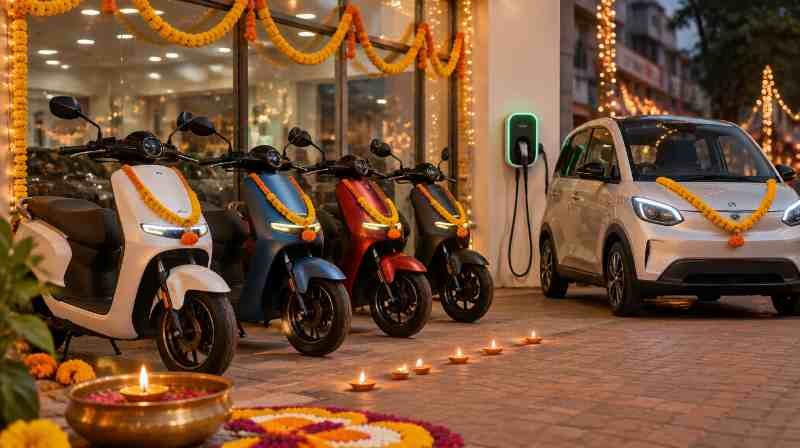
Indians bought a record 55 lakh vehicles during this year’s festive season. But look closer and the story changes: car sales actually fell, while electric vehicle sales jumped by more than half. Here is what the numbers say, and what they mean if you are thinking of buying.
The car and bike dealers’ body, FADA, calls it a record on top of a record. Over the 42 days from Navratri to just after Diwali, 55,25,490 vehicles were registered across India, 2.21% more than last year’s festive season, which was itself an all-time high.
Two-wheelers made up the bulk, at about 43 lakh. Three-wheelers rose 5.32%, tractors 2.24%, and commercial vehicles such as trucks and vans grew 7.13% to 1,55,761.
The surprise: fewer cars
Passenger vehicles, meaning cars and SUVs, went the other way. Retail sales fell 7.16% to 7,48,616, from 8,06,322 in last year’s festive season.
The main reason is last year. In September 2025, the government cut GST on cars and two-wheelers, and the price drop triggered a buying rush during that festive season. This year had to compete with that bumper base. Since then, manufacturers have raised prices again, eating into part of the GST benefit. Dealers also reported weaker demand in rural areas hit by poor rains.
The season started badly. At the Navratri stage, car sales were down more than 18%. Buyers came back around Dhanteras and Diwali, narrowing the gap to about 7% by the end.
Electric vehicles break through
The real story is electric. EV sales rose 52.62% to 5,09,667, up from 3,33,935 last year. It is the first time India has sold more than five lakh EVs in a single festive season, and EVs made up roughly one in every 11 vehicles sold.
Growth came from every corner. Electric two-wheelers rose 61%. Electric cars grew even faster, up 72.9%, even as overall car sales fell. And electric commercial vehicles more than doubled, up 154.56% to 6,387 units.
In plain terms: when Indians did buy a car or scooter this festive season, they were far more likely than before to pick an electric one.
Why EVs are taking off
Running costs are the biggest draw. Charging an electric scooter at home costs a fraction of what petrol does for the same distance, and EVs need less routine maintenance. Choice has also exploded, with many more affordable electric scooters and small electric cars on the market than two or three years ago, and charging points are becoming more common in cities.
Thinking of buying? Three things to know
Prices may rise. Carmakers are expected to raise prices again after the festive season, with Maruti Suzuki moving first. If you were planning to buy anyway, waiting may not save you money.
Check where you will charge. An EV makes most sense if you can charge at home or at work. If you live in a flat without a parking charger, check with your society before you buy.
Do the maths for your use. EVs usually cost more upfront but less to run. The more you drive, the faster the savings add up. For someone who drives a few kilometres a day, a petrol or CNG vehicle may still be cheaper overall.
What comes next
The wedding season will be the next test. The bigger question is whether car sales recover once the high base from last year’s GST cut fades, and whether price increases put off buyers. For EVs, though, the direction is clear: what was a niche a few years ago is fast becoming mainstream.
Sources
FADA festive retail data via IANS, ANI and The Tribune; two-wheeler total via Business Today; price increases via Forbes India; rural demand and GST base via Autocar Professional.
Read next



Discover more from Khabar Mitra
Subscribe to get the latest posts sent to your email.