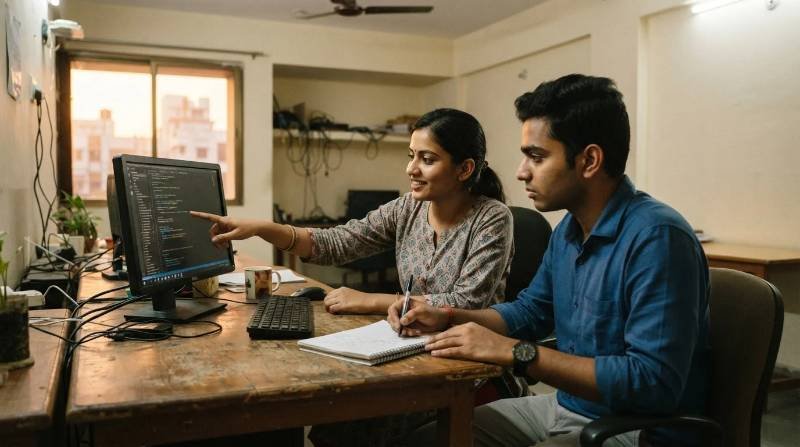
Khabar Mitra Career Guide · Issue 2 · How to become a software engineer
Also called: software developer, programmer, application developer, SDE (software development engineer), full-stack developer. In Hindi: सॉफ्टवेयर इंजीनियर / सॉफ्टवेयर डेवलपर.
What the job is: Software engineers design, write, test and maintain the programs behind apps, websites, banking systems and machines.
Pay (a year)
Company offers reported by Business Today and Careers360; AmbitionBox self-reported salaries.
Working pattern
Usually a five-day week; hybrid in many firms; some teams work late shifts to overlap with US or UK clients.
Where you’d work
IT services firms, GCCs, product companies and startups, banks, government bodies. Hubs: Bengaluru, Hyderabad, Pune, Chennai, Delhi NCR, Mumbai.
Minimum entry
A computing degree (BTech/BE, BCA, BSc, MCA) is usual; a polytechnic diploma after Class 10 is the shortest route.
1 · Understand the career
In 2007 a campus offer from Tata Consultancy Services paid ₹3.16 lakh a year. In 2026 the same entry offer pays ₹3.36 lakh, according to Business Today. That is a rise of about 6 per cent in 19 years (our calculation).
In the same hiring season, Infosys offered freshers it hires as Specialist Programmers up to ₹21 lakh a year, Business Standard reported. That is more than six times the mass-hiring offer.
Both groups are called software engineers. What separates them is mostly what a person can do on the first day of work, not only which college they went to. This guide is about closing that gap: how to become a software engineer in India, by any route, and how to start nearer the top of the range.
A typical day
- A short morning meeting with the team: what was done yesterday, what is blocked.
- Writing new code for a feature, or changing old code that someone else wrote.
- Finding and fixing bugs, often reported by testers or users.
- Writing tests that check the code works, and reviewing a colleague’s code.
- Using AI coding assistants, then checking what they produce line by line.
- Explaining progress to a team lead, product manager or client, often in English.
Who it suits, and who it doesn’t
It suits people who enjoy puzzles, can stay patient when something breaks for the tenth time, and are happy to keep learning new tools every year. Much of the documentation and team communication is in English, but reading skill matters more than polished speech, and it improves with practice.
It is a poor fit for anyone who wants the same routine for years, dislikes long hours at a screen, or expects a degree alone to secure a job.
Pros and cons
| Good | Hard |
|---|---|
| Jobs in almost every sector, from banks to farming apps | Mass-hiring starting pay is low against city rents |
| Possible without an IIT seat; skills can be shown | Tools change constantly; learning never stops |
| Pay grows fast with skill and experience | Deadlines, client time zones and on-call duty |
| Hybrid and remote roles exist | Entry-level jobs are under pressure from AI (Part 2) |
2 · Understand the industry
Who hires software engineers
- IT services firms (such as TCS, Infosys, Wipro, HCLTech) build and run software for clients, mostly abroad. They hire the most freshers.
- Global capability centres (GCCs) are in-house technology centres that foreign banks, retailers, carmakers and others run in India. India had 2,117 GCCs employing about 2.36 million people in 2025-26, according to the Nasscom–Zinnov India GCC Landscape 2026 report.
- Product companies and startups build their own apps and platforms, from e-commerce to payments.
- Banks, insurers, hospitals and manufacturers employ in-house tech teams.
- Government bodies: the National Informatics Centre (NIC) and ISRO hire through GATE (Part 3); C-DAC and others run their own recruitment.
How the industry makes money
Indian tech firms earn mostly by selling engineering time and finished software to companies abroad. In 2025-26, the industry’s revenue was estimated at $315 billion, of which $246 billion came from exports, according to Nasscom’s Annual Strategic Review 2026.
Growth, and the catch
The same Nasscom review put the workforce at about 59.5 lakh people after a net addition of 1.35 lakh in the year. Revenue grew 6.1 per cent, but headcount grew only 2.3 per cent. Companies are earning more per employee and hiring more selectively.
Licence or regulator
No licence is needed to work as a software engineer. Employers must follow laws such as India’s data protection law, the Digital Personal Data Protection Act, 2023, so engineers who understand data security and privacy are valued.
How AI is changing the job (Analysis)
In a Nasscom–Indeed report released in January 2026, 45 per cent of respondents said more than 40 per cent of their software development work is now done using AI. Nasscom president Rajesh Nambiar told Nikkei Asia that basic coding and software testing, the work that gave graduates their first jobs, is increasingly automated.
Our reading: the beginner’s job is moving from typing simple code to checking, testing and joining together code that AI writes. That needs stronger basics, not weaker ones. The same Nasscom–Indeed report found 40 per cent of employers prefer demonstrated AI skills or certifications over degrees alone.
See also: Career Guide No. 1: Cyber security
3 · How to become a software engineer
You can become a software engineer in India through:
- a polytechnic diploma after Class 10
- a degree after Class 12 (BTech/BE, BCA or BSc)
- a postgraduate course after graduation (MCA, MTech)
- an apprenticeship after a diploma or degree
- a government job through GATE
- moving across from a related job
After Class 10: polytechnic diploma
What it is: a three-year diploma in computer engineering or IT from a government or private polytechnic.
You’ll usually need: Class 10 pass and your state’s polytechnic entrance test (for example JEECUP in Uttar Pradesh or DCECE in Bihar).
After it: apply for junior developer or support roles, or join the second year of a BTech through lateral entry, which saves a year. Diploma holders can also train as paid apprentices (see below).
After Class 12: a degree
BTech/BE in computer science or IT (four years)
- You’ll usually need: Physics, Chemistry and Maths in Class 12.
- Entrance: JEE Main for NITs, IIITs and many other colleges; JEE Advanced for IITs; state tests such as MHT CET or KCET; some private universities run their own tests.
BCA or BSc Computer Science (three years)
- You’ll usually need: Class 12 pass. Many universities ask for Maths in Class 12, so check each college.
- Entrance: CUET-UG at central and many state universities, or the college’s own merit list.
- After it: a job, or an MCA for a stronger profile.
After graduation: MCA or MTech
- MCA (two years): NIMCET is the entrance test for about 1,300 MCA seats at 11 NITs and two IIITs. It requires Maths and scores it separately. Other universities run their own tests or use CUET-PG.
- MTech: admission is mainly through GATE (Computer Science paper).
Apprenticeship: paid training on the job
Under the National Apprenticeship Training Scheme (NATS), companies train fresh graduates and diploma holders for up to a year. The minimum monthly stipend from 1 April 2026 is ₹12,300 for graduates and ₹10,900 for diploma holders, according to a notice from the Board of Practical Training (Eastern Region). The government pays half through direct benefit transfer. Register on the NATS portal.
Government route: GATE
Central bodies recruit software engineers using GATE scores plus an interview:
- NIC Scientist-B: the 2026 notice had 243 posts, 168 of them in computer science and IT. The post is at Pay Level 10 (basic pay ₹56,100 a month). It accepts BE/BTech, MCA, MSc or MTech with a valid GATE score.
- ISRO Scientist/Engineer ‘SC’: also Pay Level 10. The computer science post asks for a BE/BTech with at least 65 per cent or a CGPA of 6.84, plus a valid GATE score.
Seats are few. Treat this as one route among several, not the only plan.
Moving across from a related job
Testers, support engineers and engineers from other branches often move into development. Most do it by building a portfolio of working projects and passing a company’s coding test.
What it costs
What four years of IIT BTech tuition costs, by family income (₹ lakh)
Fees at private colleges vary widely: always check the college’s official fee notice before you take a seat. Sources: IIT fee rules as reported by IIT Madras and IIT Kanpur notices; NPTEL; BOPT.
Scholarships
- AICTE Pragati: ₹50,000 a year for girl students in AICTE-approved degree or diploma courses. Family income must be up to ₹8 lakh. Apply on the National Scholarship Portal; the 2026-27 deadline was 31 October 2026.
- IIT merit-cum-means: a monthly allowance plus a tuition waiver for students with family income below ₹4.5 lakh (details vary by IIT).
From a small town, or from a Hindi-medium school?
You don’t need to move to a metro to learn. NPTEL courses are free to learn and taught by IIT and IISc faculty. Company coding tests are online. English matters most for reading documentation and writing clearly, and that improves with daily practice.
4 · Skills and what it takes
| Skill area | What it means | Free or cheap ways to build it |
|---|---|---|
| Core computing | One language well (Python, Java or C++), data structures and algorithms, databases (SQL), how the web works | NPTEL courses such as Data Structures and Algorithms Design (IIT Kanpur) and An Introduction to Programming through C++ |
| Tools | Git and GitHub, a code editor, testing, basic cloud, using and checking AI coding assistants | Free tiers of the big cloud providers; put every project on GitHub |
| People skills | Explaining your work, writing clearly, asking for help early, working to deadlines | College tech clubs, hackathons, open-source projects |
Employers in the Nasscom–Indeed study listed Agile working, communication, APIs and Git among the skills they look for in software engineers.
5 · Pay and progression
Yearly pay, ₹ lakh
Bars: pay ranges. Dot: government basic pay only.
Private sector (range)
Government entry post (basic pay)
Pay is usually higher in Bengaluru, Hyderabad, Pune and Delhi NCR, but so are rents. A ₹4 lakh offer in Indore or Kochi can leave more money at the end of the month than a ₹5 lakh offer in Bengaluru.
A typical career ladder
- Trainee / associate engineer (0–2 years): fixes bugs, builds small features under supervision.
- Software engineer (about 2–4 years): owns features end to end.
- Senior software engineer (about 3–9 years, per AmbitionBox data): designs parts of systems and reviews others’ code.
- Lead engineer (about 4–12 years): guides a team’s technical choices.
- Then a fork: architect or principal engineer (deeper technical work) or engineering manager (people and delivery).
Where else it can lead
Data engineering, cyber security, cloud and DevOps, AI engineering, product management, technical sales, or your own startup. Upcoming Career Guides cover data engineering and AI engineering.
6 · Get the job
Where to apply
- Campus placements, if your college has them.
- Company hiring tests open to all graduates, such as TCS NQT, Infosys HackWithInfy and Wipro’s National Level Talent Hunt. These don’t depend on your college’s name.
- Job and internship portals such as Naukri, LinkedIn and Internshala, and company career pages.
- The NATS portal for paid apprenticeships.
- GATE, then the NIC and ISRO recruitment notices.
Your CV
Recruiters look for proof you can build something. Two or three working projects with code on GitHub beat a long list of courses.
Worked example (illustrative):
- Before: “Worked on a college project using Python.”
- After: “Built a library-return tracker in Python and SQLite used by 400 students at my college; added email reminders and wrote tests for the late-fee calculation. Code: github.com/yourname/library-tracker”
The second version says what you built, who used it and what you did, in one line.
Common interview questions, and what a good answer covers
- “Walk me through a project you built.” What problem it solved, your part in it, one hard bug and how you fixed it.
- A coding problem (for example, finding duplicates in a list). Talk through your approach first, handle edge cases, and state how fast it runs.
- “What happens when you type a website address and press Enter?” The basic steps: DNS lookup, request, server, response, page.
- Database question (for example, the difference between types of joins). A short example table helps.
- “How do you use AI tools when you code?” Where they helped, and how you checked the output was correct.
- “Are you open to shifts or relocation?” Be honest; ask what the project needs.
From the field
Are you a software engineer, especially outside the big metros? Tell us how you got your first job: write to khabarmitra986@gmail.com. We publish real accounts only, with your permission.
In 60 seconds
- Software engineers write, test and maintain the code behind apps and systems.
- Routes: polytechnic diploma after 10th, BTech/BCA/BSc after 12th, MCA/MTech after graduation, paid NATS apprenticeships, or GATE for NIC and ISRO.
- Pay starts around ₹3.4 lakh at mass recruiters but can reach ₹7–21 lakh for strong freshers; seniors report up to about ₹27 lakh.
- AI is taking over simple coding; strong basics, real projects and checking AI’s work matter more than ever.
FAQ
Can I become a software engineer without a BTech?
Yes. BCA, BSc and MCA graduates are hired widely, and NIC accepts MCA and MSc holders with a GATE score. Company hiring tests judge skills, not only degrees.
Do I need Maths in Class 12?
For BTech, yes. Many BCA courses and NIMCET also require Maths. Some universities admit students without it, so check the specific course.
Is AI ending software jobs?
The industry is still adding jobs, but more slowly than revenue (Nasscom). Simple coding and testing work is shrinking; work that needs judgement, design and checking is growing.
Also read: Careers with Geography in India: the Khabar Mitra Career Map · Career Guide No. 1: Cyber security
Sources
- Nasscom, Annual Strategic Review 2026 (revenue, exports, workforce), as reported by Business Standard, 24 February 2026
- Nasscom–Zinnov, India GCC Landscape 2026 (2,117 GCCs, 2.36 million people), as reported by Business Today, 7 May 2026
- Nasscom–Indeed report on human–AI collaboration, January 2026 (Storyboard18)
- Nasscom–Indeed report: skills and certifications employers prefer (CXOToday)
- Rajesh Nambiar on AI and entry-level jobs, interview with Nikkei Asia (via AI Weekly)
- Business Today, 9 February 2026: IT fresher pay ₹3.16 lakh (2007) and ₹3.36 lakh (2026)
- Business Standard, 26 December 2025: Infosys fresher roles from ₹7 lakh to ₹21 lakh
- Careers360: TCS and Infosys entry salaries
- AmbitionBox: Software Engineer salaries (self-reported)
- AmbitionBox: Senior Software Engineer salaries (self-reported)
- ISRO Centralised Recruitment Board: Scientist/Engineer ‘SC’ notices (official)
- NIC Scientist-B Recruitment 2026 notice (243 posts, Pay Level 10)
- NIMCET 2026 information brochure, NIT Tiruchirappalli (official)
- BOPT (Eastern Region) notice on revised NATS stipends from 1 April 2026, via TeamLease RegTech
- National Apprenticeship Training Scheme portal (official)
- IIT Madras fee structure 2026 (official)
- AICTE Pragati scholarship, National Scholarship Portal (official)
- NPTEL: Data Structures and Algorithms Design, IIT Kanpur (official)
Next Sunday: Career Guide No. 3: Insurance underwriting.
Get each issue on WhatsApp: join the Khabarmitra Career Guide channel · All Career Guides and Career Maps →
Read next



Discover more from Khabar Mitra
Subscribe to get the latest posts sent to your email.