
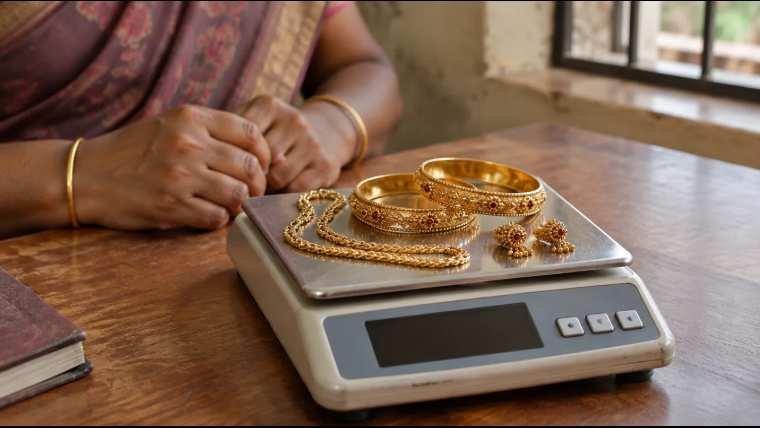
If you have a gold loan, the jewellery you pledged is now worth roughly 30 per cent less than at its January peak, and lenders are watching. Gold has slipped from about ₹1.80 lakh per 10 grams to around ₹1.22 lakh to ₹1.26 lakh, and gold loan defaults have nearly doubled this year. For most borrowers nothing happens automatically, but a falling price can mean a call from your lender asking you to pay part of the loan or pledge more gold.
What has happened to gold loans?
Gold loans became India’s fastest-growing kind of secured borrowing while prices climbed. Loans against gold jewellery reached ₹3.74 lakh crore in September 2026, up 66 per cent in a year and more than double the ₹1.50 lakh crore of September 2024, according to RBI data reported by Business Today.
Now the price has turned. The share of gold loans that have gone bad (unpaid for 90 days or more) rose from 0.16 per cent on 31 March to 0.30 per cent at the end of August, credit bureau TransUnion CIBIL’s data show. That is still small, but it nearly doubled in five months. The RBI raised concerns about aggressive gold lending at a recent meeting with heads of non-bank lenders, Dhanam and Business Today reported. The RBI has not published a statement on that meeting.
Why does a lower gold price matter for my gold loan?
Because the rules cap how much you can owe against your gold, and that cap applies for the whole loan, not just on the day you borrow. The cap is called the loan-to-value ratio, or LTV: the loan as a share of what your gold is worth.
Under the RBI’s gold and silver lending rules, which lenders had to follow by 1 April 2026, the cap is 85 per cent if your total consumption gold loans are up to ₹2.5 lakh, 80 per cent between ₹2.5 lakh and ₹5 lakh, and 75 per cent above ₹5 lakh. If you repay everything in one go at the end (a “bullet” loan), the interest due at maturity is counted too. The rules say the LTV “shall be maintained on an ongoing basis throughout the tenor”.
So when gold falls, your debt stays the same but the gold behind it shrinks. Take a family in Kanpur that pledged bangles worth ₹2 lakh in January for a 12-month bullet loan of ₹1.5 lakh at an assumed 12 per cent. They will owe ₹1.68 lakh at the end, which was 84 per cent of the gold’s value, just inside the limit.
How a falling gold price pushes a loan over the limit
Amount owed at maturity (₹1,68,000) as a share of the pledged gold’s value. Dashed line: the 85% limit. One scale for all bars.
After a 30 per cent fall the same bangles are worth ₹1.4 lakh, less than the ₹1.68 lakh the family owes. To get back to the 85 per cent limit they would have to repay about ₹49,000 or pledge more gold.
When gold falls, your debt stays the same but the gold behind it shrinks.
Can the lender sell my gold?
Only after notice, and only under set rules. The RBI rules do not spell out what a lender must do the day the limit is crossed; that depends on your loan agreement and the key fact statement you were given. What they do require if it comes to an auction:
- Notice first: you must get adequate notice to repay before any auction starts. If you cannot be traced, the lender must wait one month after a public notice.
- A floor price: the reserve price must be at least 90 per cent of the gold’s current value, falling to 85 per cent only if two auctions fail. The lender and its related parties cannot bid.
- Your surplus back: anything left after clearing the dues must reach you within seven working days of the lender receiving the money.
- Gold back on time: once you repay in full, your gold must be returned the same day, and at most within seven working days. If the delay is the lender’s fault, it owes you ₹5,000 for every extra day.
Is this a crisis?
The numbers do not show one yet. A 0.30 per cent bad-loan rate is low by the standards of most lending. Crisil Ratings’ Krishnan Sitaraman told PTI that gold loans remain attractive to lenders and that the agency does not expect a significant rise in credit costs, though it sees loan growth slowing to about 40 per cent this financial year from 78 per cent last year.
The pressure falls on particular borrowers: those who took loans near the January peak, those with bullet loans where interest keeps adding up, and those with several gold loans at once. Piramal Finance chief executive Jairam Sridharan told Business Today that, over the past year, 15 to 23 per cent of gold loan money went to borrowers already 90 days behind on another loan. Many of these are small traders and farming households who borrow against family jewellery when other credit is hard to get.
The bottom line
Check two numbers today: what you will owe at the end of your gold loan, and what your gold is worth at today’s rate. If the first is more than 85 per cent of the second, talk to your lender before it calls you. Paying the interest now, or a small part of the principal, is usually cheaper than an auction. Keep the notice and the key fact statement, and know your rights on notice, reserve price and the return of your gold.
This is general information, not financial advice. It names no lender and does not suggest buying or selling gold. Gold prices change daily; figures checked on 26 November 2026.
FAQ
Will my lender auction my gold if the price falls?
Not without notice. You must be given a chance to repay first, and any auction must follow the RBI’s floor price and surplus-refund rules. What triggers the process is set out in your loan agreement.
How does the lender value my gold?
At the lower of the previous day’s closing price and the average of the last 30 days, for your gold’s actual purity, using IBJA or a SEBI-regulated exchange. Stones and making charges add nothing.
Can I renew my bullet gold loan?
Yes, but consumption bullet loans are capped at 12 months, and renewal is allowed only after you pay the interest due and only if the loan stays within the LTV limit.
What if my gold is not returned after I repay?
It is due the same day and at most within seven working days. If the delay is the lender’s fault, it must pay you ₹5,000 a day beyond that. Complain to the lender first, then to the RBI Ombudsman.
Also read: Indians bought 40% less gold this year: what that means for you · Is your 22-carat gold really 22 carat?
Sources
RBI, Lending Against Gold and Silver Collateral Directions, 2025 (6 June 2025, updated 29 September 2025; paras 4, 6, 15, 17, 19, 20, 35, 37, 40, 42, 43, 46); Business Today, 24 November 2026 (RBI data on loans against jewellery; TransUnion CIBIL NPA data; Crisil and Piramal Finance comments; price peak); Dhanam, 24 November 2026 (RBI meeting with lenders); gold rates on 26 November 2026 from IIFL (Delhi 24K ₹1,22,930 per 10 g) and Goodreturns (24K ₹1,25,890). Worked example and chart: our calculation.
Read next



Discover more from Khabar Mitra
Subscribe to get the latest posts sent to your email.
1 thought on “Gold is down 30% from its peak. What it means if you have a gold loan”