
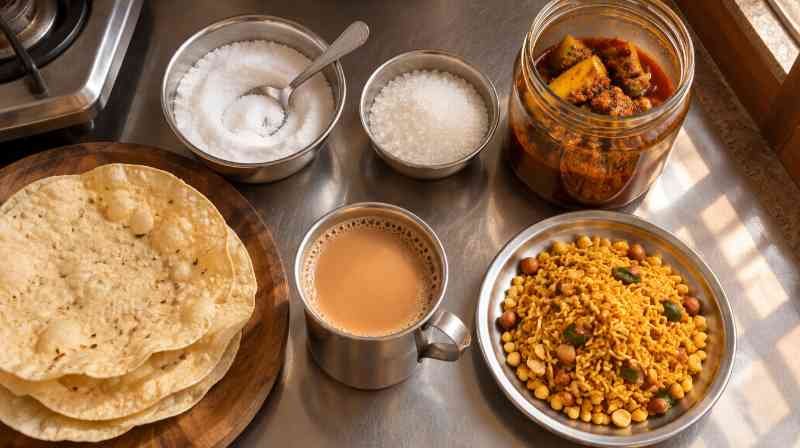
Salt intake in India averages 8 g a day for adults, according to ICMR’s national survey of non-communicable diseases. The limit set by both WHO and ICMR’s nutrition institute is 5 g. The average Indian adult eats 60 per cent more salt than that.
High salt raises blood pressure, and high blood pressure is a leading cause of stroke, heart attack and kidney failure. Sugar, the other half of this story, is linked to weight gain, type 2 diabetes and tooth decay. Both are easy to overeat without noticing, because most of it is already in the food before it reaches the plate.
Salt intake in India: what the surveys show
| Group | Salt per day | Compared with 5 g limit |
|---|---|---|
| All adults (ICMR national survey) | 8.0 g | +60% |
| Men | 8.9 g | +78% |
| Women | 7.1 g | +42% |
| Urban adults (ICMR-NIE, 2025) | 9.2 g | +84% |
| Rural adults (ICMR-NIE, 2025) | 5.6 g | +12% |
The national survey also found that fewer than one adult in three knew that eating a lot of salt every day could harm their health. That gap matters more than any single number: people cannot cut what they do not see.
Note that the surveys measure salt from all sources, including what is already in bread, pickles and packaged snacks. Most of it does not come out of the salt box at the table.
What 5 g of salt looks like in a day
Five grams is about one level teaspoon of salt, for everything you eat in a day. Tested and surveyed figures for common Indian foods show how fast it goes:
| Food | Salt | Share of 5 g |
|---|---|---|
| Masala instant noodles, one 70 g pack (CSE lab test) | 2.6 g | 52% |
| Pickle, one tablespoon (about 15 g) | 0.6 g to 2 g | 12% to 41% |
| Papad, per 100 g (average) | About 3 g | 61% |
| Namkeen, 100 g bowl at 800 mg sodium (worked example) | 2 g | 40% |
The same survey found huge gaps between similar products. Papads ranged from almost no sodium to 4,000 mg per 100 g, which shows that low-salt versions can be made. Checking the label is how you find them.
Add the salt in home-cooked dal, sabzi and rotis, and an ordinary day can reach 8 g without anything that tastes especially salty. Papad, chutney powders, sauces, chaat masala and street foods like vada pav or pav bhaji push it higher.
How much sugar do Indians eat?
Sugar intake is harder to measure, because there is no national survey of added sugar like the salt one. What we have is sales data. The Indian Sugar and Bio-Energy Manufacturers Association estimates consumption at about 19.8 kg per person in the 2024-25 sugar season.
Our calculation: 19.8 kg spread over 365 days is about 54 g a day per person. That is roughly double the limit in ICMR-NIN’s guidelines.
This is not a measure of what each person eats. It covers all sugar sold, including sugar used by mithai shops, drinks makers and other industries, and some that is wasted. It also leaves out gur and khandsari. Treat it as a rough upper indicator, not intake.
What the limits actually are
| Who sets it | Salt | Sugar |
|---|---|---|
| ICMR-NIN, Dietary Guidelines for Indians 2024 | Up to 5 g a day (2,000 mg sodium); use iodised salt | Under 5% of energy, about 25 g a day on 2,000 kcal; no added sugar for children under 2 |
| WHO | Under 5 g a day | Free sugars under 10% of energy, ideally under 5% |
| FSSAI label reference (%RDA) | 2,000 mg sodium | 50 g added sugar |
The 25 g sugar limit is about six level teaspoons, for everything: tea, biscuits, sweets, cold drinks and the sugar hidden in ketchup or breakfast cereal. Two cups of chai with two spoons each already use most of it.
NIN’s guidelines count sugar from honey, jaggery and fruit juice as sugar too. Gur may be less refined, but the body handles it largely the same way.
Where the salt and sugar come from
- Packaged snacks and instant foods: namkeen, chips, instant noodles and biscuits carry salt even when they taste sweet.
- Preserved foods: pickles, papad and chutney powders are among the saltiest things in an Indian kitchen.
- Bakery and bread: bread, rusks and pav add salt through the day in small amounts.
- Drinks: sweetened tea and coffee, cold drinks, packaged juices and flavoured milk are the quickest way past the sugar limit.
- Festive and street food: mithai, chaat and fried snacks combine salt, sugar and fat.
What is being done about it
ICMR-NIE runs a three-year salt reduction project in Punjab and Telangana, in which health workers at Health and Wellness Centres counsel people with high blood pressure. Its scientists say switching to low-sodium salt, in which part of the sodium is replaced with potassium, can lower blood pressure by about 7/4 mmHg on average.
Low-sodium salt is not for everyone. People with kidney disease or those on some blood-pressure medicines should check with a doctor first, because extra potassium can be harmful for them.
At the shop, FSSAI’s proposed red warning label for foods high in sugar, salt or saturated fat is before the Supreme Court, which reserved its judgment on 28 September 2026; as of 24 November no ruling had been reported. Until then, the back of the pack is the best guide. Our step-by-step guide to reading food labels shows how.
What you can do now
- Taste before you salt at the table, and keep the salt box off it.
- Cut pickle and papad to a small side, not a daily habit.
- Compare snacks on sodium per 100 g; multiply by 2.5 for salt.
- Reduce sugar in chai gradually: half a spoon less each week is easier than stopping.
- Swap cold drinks and packaged juice for water, lassi without sugar, or whole fruit.
This is general information, not medical advice. If you have diabetes, high blood pressure, kidney disease or another condition, please follow your doctor’s advice on salt and sugar.
Also read: How to read food labels in India · Why your kitchen bill keeps rising
Sources and method
- Scientific Reports (2023): salt intake in India, ICMR National NCD Monitoring Survey
- ANI via Babushahi: ICMR-NIE on excess salt intake, 13 July 2025
- The George Institute for Global Health: Salt content of processed foods in India, June 2016
- Down To Earth: CSE lab tests of salt in packaged foods
- ICMR-NIN: Dietary Guidelines for Indians, 2024
- Down To Earth: NIN guidelines on labels and sugar, May 2024
- WHO: Salt reduction fact sheet
- WHO: Guideline on sugars intake for adults and children (2015)
- ChiniMandi: ISMA estimates of per-capita sugar consumption, 2024-25
- FSSAI: Food Safety and Standards (Labelling and Display) Regulations, 2020
- LawBeat: Supreme Court reserves judgment on front-of-pack warning labels, 28 September 2026
- Method: percentages over the limit, salt conversions and the per-day sugar figure are Khabar Mitra’s calculations from the sources above. The namkeen row is a worked example.
Read next


Discover more from Khabar Mitra
Subscribe to get the latest posts sent to your email.