
Six months ago, Nepal’s new prime minister was asking China and Britain to step into a border row with India. On Monday he stood next to Narendra Modi in Delhi as India announced its biggest-ever aid package for Nepal. Here is what changed, what India gets out of it, and what is still unresolved.
The gifts said a lot. Modi handed Balendra Shah a kalash of Gangajal from the Triveni. Shah gave Modi rudraksha and sandalwood from Kathmandu’s Pashupatinath temple. Two Hindu-majority neighbours, reminding each other, and everyone watching, how much they share.
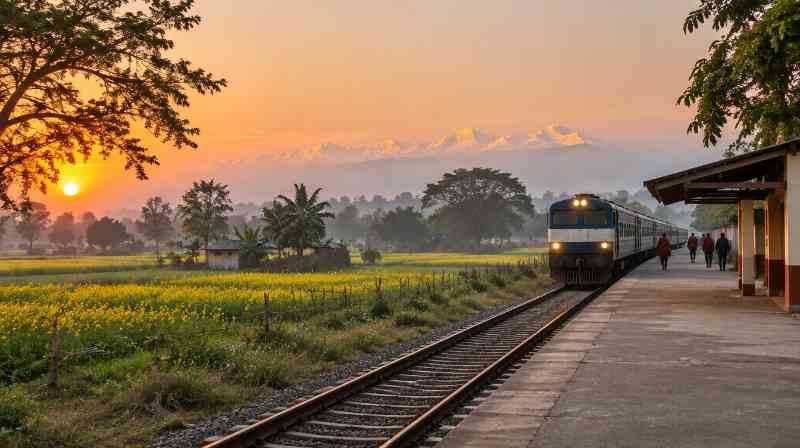
Then came the numbers. After talks at Hyderabad House, Modi announced a development package worth 240 billion Nepali rupees. That is about ₹15,000 crore, or $1.62 billion. The two sides signed eight agreements, opened a new train between Ayodhya and Janakpur, and agreed to a joint vision document for the first time.
It was Shah’s first official trip abroad since he became prime minister in March. He cut it to about 25 hours, but packed a lot in.
Why Nepal needed help now
On the morning of 26 August, with no rain falling, the Bhotekoshi river in Nepal’s Rasuwa district suddenly rose. A mass of rock and glacier ice had collapsed high up near the Tibet border, sending a wall of water and debris down the valley.
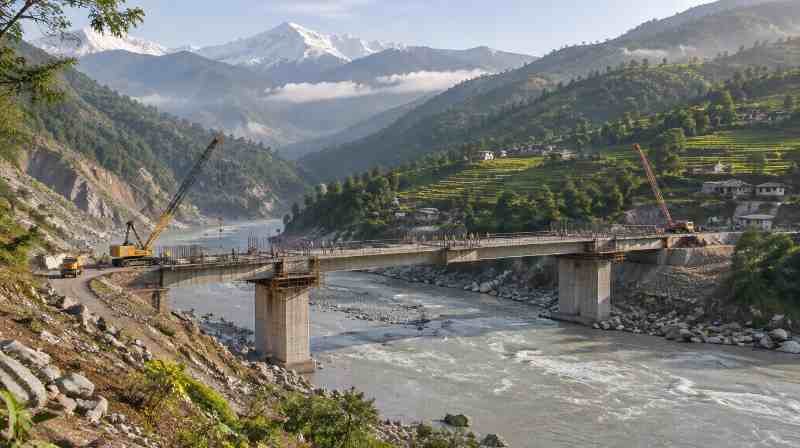
It became one of the worst disasters in Nepal’s recent history. By early September, Nepal’s disaster agency had counted 1,342 deaths, with almost 4,900 people still missing or out of contact. More than a hundred Indian tourists were among those first reported missing. Bridges, roads and hydropower plants along the Bhotekoshi and Trishuli rivers were destroyed, along with the only year-round road link between Kathmandu and Tibet.
Nepal put the damage at about $1.66 billion and the full cost of recovery at $4.77 billion. It came to Delhi asking for more than $2 billion. It got $1.62 billion.
Where the ₹15,000 crore is going
Only part of it is a gift. About ₹3,500 crore is a grant, mainly to repair hydropower projects wrecked by the floods. The remaining ₹11,500 crore is a line of credit, a cheap loan, for energy projects such as transmission lines that carry Nepali electricity into India.
In other words, the package is almost entirely about power. And that is no accident.
Nepal’s rivers can generate far more hydroelectricity than the country needs. India already buys about 1,200 MW from Nepal, and the two have targeted 10,000 MW by 2030. On Monday the two leaders virtually laid the foundation stone for the 669 MW Lower Arun hydroelectric project, and agreed to look at gas pipelines too. More Nepali power means cleaner electricity for north Indian states and steady income for Nepal.
What else was agreed
For young Nepalis, the headline was education. India will set up an offshore campus of IIT Kanpur in Nepal, along with a start-up incubator and an innovation hub, and will expand scholarships. Shah went a step further, saying he hoped Indian students would one day come to study at an IIT in Nepal.
For trade, India offered Nepal, which has no coastline, transit access through Kandla port in Gujarat, and through Paradip in Odisha once facilities are ready. The two sides also agreed to review their trade rules and to set up special economic zones near the border for export-focused factories. India is Nepal’s biggest trading partner by far, supplying about 63% of its imports.
The eight agreements cover policing, forensic science, civil service training, traditional medicine, satellite communication, urban development, healthcare, and livestock and fisheries. A new road bridge between Dharchula in Uttarakhand and Darchula in Nepal was opened, and work began on a new border checkpost at Banbasa. There was even a promise of help with cricket grounds and coaching.
The man in the room
Balendra Shah, known as Balen, is not a typical South Asian leader. He is 36, a former rapper, and came to power in March after a landslide election that followed last year’s youth-led protests in Nepal. He has a habit of doing things his own way. In May, he declined to meet the US ambassador to India when he visited Kathmandu, saying he meets only his political counterparts.
That independent streak is why Delhi had been watching him nervously.
The border row that nearly soured things
The trouble started in April, when India and China announced that the Kailash Mansarovar Yatra would again use the Lipulekh pass. Nepal says Lipulekh, along with Kalapani and Limpiyadhura, belongs to it under the Sugauli Treaty, signed with the British in 1816. India says the area is part of Uttarakhand, and that pilgrims have used Lipulekh since 1954.
Then, in his first speech to Nepal’s parliament on 31 May, Shah said Nepal had raised the issue with China and the United Kingdom as well as India, arguing that Britain should take an interest because the dispute dates back to colonial rule. Delhi hit back within days, saying there was no role for any third party.
Monday’s visit did not solve the dispute, but it changed the tone. The two leaders asked their foreign secretaries to work on the boundary question, and the new vision document sets up a mechanism for it. They quietly dropped a decade-old report on the relationship by an “Eminent Persons’ Group”, which officials now call “a thing of the past”. And they agreed that older agreements, including the 1950 Treaty of Peace and Friendship that many Nepalis feel is one-sided, can be reviewed by mutual consent.
So what is India really getting?
Three things. First, electricity: a reliable, low-carbon supply from next door. Second, influence. China has been courting Nepal with roads, railways and loans for years, and the August floods hit the very road that links Nepal to Tibet. A big, visible Indian package, arriving when Nepal is hurting, is a reminder of who shows up first. Shah himself called India a “first responder in times of natural disasters”.
Third, a working relationship with a young, popular leader who could be around for a while, and whose generation will decide how Nepal sees India for decades.
What changes for ordinary Indians
The most direct change is the new Saryu-Kamala Express, a weekly train between Ayodhya Cantt and Janakpur Dham, the city linked to Sita. It connects two of the most important places in the Ramayana and should be popular with pilgrims on both sides. More routes for Buddhist and Shiva-Shakti pilgrimage circuits are being explored.
Flights are still a work in progress. Nepal wants new routes through Indian airspace into its newer airports at Pokhara and Bhairahawa, near Lumbini. India, in turn, wants access to Nepali airspace near the narrow Siliguri corridor. Both sides agreed to open new air routes, but gave no details.
What to watch next
Announcements are the easy part. India’s past record in Nepal is mixed: of a $750 million credit line announced in 2015, about $550 million has been used so far. The real test is whether the money reaches flood-hit villages and power projects quickly, whether the IIT campus actually opens, and whether the foreign secretaries make progress on Lipulekh before the next pilgrimage season.
For now, both sides got what they needed from a 25-hour visit: Nepal got money for recovery, and India got a reset with a neighbour that had been drifting.
Sources
Business Standard (package break-up, 21 outcomes, boundary mechanism); Reuters; Outlook (train, gifts, air routes); The Tribune / ANI; flood figures from Nepal’s NDRRMA via Copernicus / FloodList and IANS; border row via ThePrint and The Kathmandu Post; trade share from World Bank data via AFP.
Read next



Discover more from Khabar Mitra
Subscribe to get the latest posts sent to your email.